"The first few months of our lives are spent bald, in a diaper, and in the fetal position. Often, the last few months of our lives are spent the same way." That idea always stuck with me. But there's something to be said for how our bodies develop, and how they then begin to break down. Think about it. We all start in the 'fetal position' inside our mother's womb, all curled up in a ball. Over time, we learn to crawl, then stand, then walk, then do all sorts of fun things. We stand tall. We are young, strong, and capable of many activities.
Then...'life' happens. And we end up sitting in a chair in front of a computer, or on the couch for far too many hours, or looking down at the assembly line in front of us. Over time, we begin to lose our height and our ability to stand up tall. This is not a good thing.
Although the name "Dowager's Hump" implies that this condition is one that affects elderly women (which it primarily does), it can also affect anyone who spends a lot of time hunched over or who has a severe case of osteoporosis, including men.
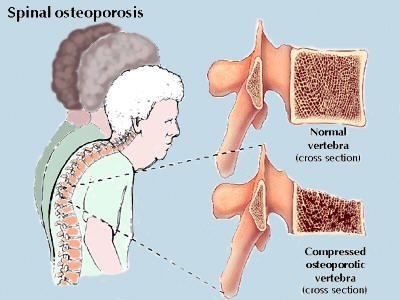
The medical term for Dowager's Hump is hyperkyphosis, which is an increase in the forward curvature of the lower cervical and upper thoracic spine. It is a condition that can either be relatively painless or can cause considerable pain and discomfort. Dowager's hump is common in people with osteoporosis and is usually due to what is called a wedge fracture. This is when the front part of the vertebra (the side facing your chest) collapses, causing the vertebra to tilt forward, which forces the back to curve and the head to jut forward. In some cases the curvature is so severe that it forces the head to look downward. It can become a sort of domino effect, with the collapsed vertebra tilting and putting pressure on the one below, until it too subsequently fractures and tilts, etc. In advanced osteoporosis, the bones of the vertebrae can become so porous that they may fracture as a result of lifting something or simply from coughing or sneezing. A wedge fracture does not necessarily cause pain, and the first signs of it may be a loss in height or an obvious rounding of the upper back. Other people are more likely to see it before the person suffering from the disorder, as we do not generally see ourselves from the side.
Someone with hyperkyphosis may also experience neck pain, breathing difficulties, rib pain and loss of appetite. Symptoms may be worse when coughing or sneezing and may be relieved when lying down. Those with mild cases of hyperkyphosis may find some relief through yoga. A study published in the Journal of the American Geriatrics Society found that elderly women with Dowager's Hump who took yoga classes three times a week for six months had a slight reduction in the curvature of their spine.

No comments:
Post a Comment