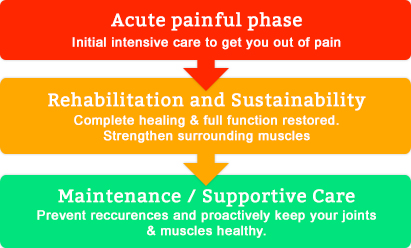
To really understand the importance of maintenance care in Chiropractic, it is necessary to understand the other types of care as well. There are three main types of care that an individual will undergo while at a Chiropractic office: 1) initial intensive care, 2) corrective care, and 3) maintenance care. Each of these three types of care are essential in the process of getting an individual better and, just as important, keeping them better for the long term.
One important fact to remember as we go through the different types of care is that symptoms are only part of the injury, not all of the injury. When an injury or problem occurs, the symptoms are what motivate us to seek care, but they are not necessarily what require care. Pain is the most common symptom associated with an injury. Other common symptoms include numbness, tingling, loss of function, swelling of the area, a red coloration of the skin, and increased temperature over the injury-just to name a few.
Initial Intensive Care
This type of care is Step 1 when a new injury occurs or an old injury resurfaces. Initial intensive care consists of a large number of visits in a short period of time-sometimes even at a frequency of 3 times a week for 3-4 weeks. This allows the Chiropractor to make significant changes fairly quickly and often decrease the amount of pain or discomfort an individual is experiencing. It is not uncommon for individuals to experience large improvements in both symptoms and function during this period.
Corrective Care
Corrective care is the second step in the healing process. Although a majority of the symptoms may have improved, muscle and other soft tissue damage may still be present depending on the severity of the initial injury. Visit frequency is decreased during corrective care, and stretching and exercises are often used to further the healing process. This stage is very important in attempting to fix the underlying problem that originally caused the symptomatic state. Often times the symptoms will vanish completely in corrective care, but it is important to remember that this does not mean that the problem is solved.
Maintenance Care
Once maximum improvement is reached through the initial intensive care and corrective care steps, maintenance care is highly recommended. Although maintenance care cannot guarantee that the problem will never return, it does significantly decrease the chances as well as make dealing with that problem significantly easier. Individuals who receive maintenance care tend to have fewer reoccurring problems and recover more quickly when they do. Maintenance care is also beneficial in that it can detect other issues early to make sure they are dealt with before they become more serious problems. Visit frequency for maintenance care is suggested at 1 visit every 4-6 weeks.
Here's a great example of how maintenance care can help. It's a true story about two different patients who presented to our office recently. Both of these patients originally came to the office for low back pain in the past. Both made it through the initial intensive care and corrective care stages to end up pain and symptom free. Patient 1 (whom we will call John) decided to pursue a maintenance care schedule, coming in every 6 weeks for continued care. Patient 2 (whom we will call Sara) decided to discontinue care after she was feeling better and her symptoms had decreased. This is where the story begins. John and Sara, two patients with similar problems, decide to take different routes after feeling better.
Fast forward to this past April when John and Sara present to the office on the same day with an exacerbation of their original low back issues. Both John and Sara had 9/10 pain (10 being the worst possible pain), had difficulty functioning, and were seen 5 times over the next 10 days. Both patients were treated with similar Chiropractic techniques and therapies as well. John, who had been following the recommended maintenance care schedule, had improved to a 2/10 pain level after only 4 visits and experienced increased functionality as well. Sara, who had discontinued care after starting to feel better from her previous injury, improved to a 7/10 pain level after 5 visits. After continuing with care, Sara was down to a 4/10 pain level after 10 visits and continued to improve with care. This is a drastic difference in responses to care. John was able to get back to his daily routine much faster than Sara and with significantly less care. Getting back to normal faster means less time off work, a decrease in the length of time you are in pain, and less time being immobile due to pain when you could be active and enjoying life.

No comments:
Post a Comment